Electric motors have been essential to many technologies, from home appliances to heavy industrial machines. However, as industries seek greater efficiency, lower maintenance, and smarter automation, traditional brushed motors (brushless motor) are showing their limitations.
This brings us to the brushless motor, an innovative development that has revolutionized the way motion, power, and precision work together. Unlike regular motors that depend on brushes for electrical contact, brushless motors use electronic control systems. This results in smoother rotation, longer lifespan, and improved energy efficiency.
By 2025, brushless motor technology is expected to have exceeded expectations. These motors now drive many applications, including drones, electric vehicles, robotics, aerospace systems, and AI tools for automation. Their capacity to provide high torque, generate minimal heat, and operate almost silently makes them vital to modern engineering.
What Is a Brushless Motor? (BLDC Explained)
A brushless motor, often referred to as a BLDC motor (Brushless DC Motor), is a type of electric motor that operates without physical brushes. This design makes it more efficient, durable, and precise than traditional brushed motors.
Unlike older motors that rely on mechanical brushes and commutators to switch electrical current, a brushless motor utilizes electronic commutation, which a controller manages. This digital switching technology reduces friction, lessens wear and tear, and allows for smoother performance at varying speeds.
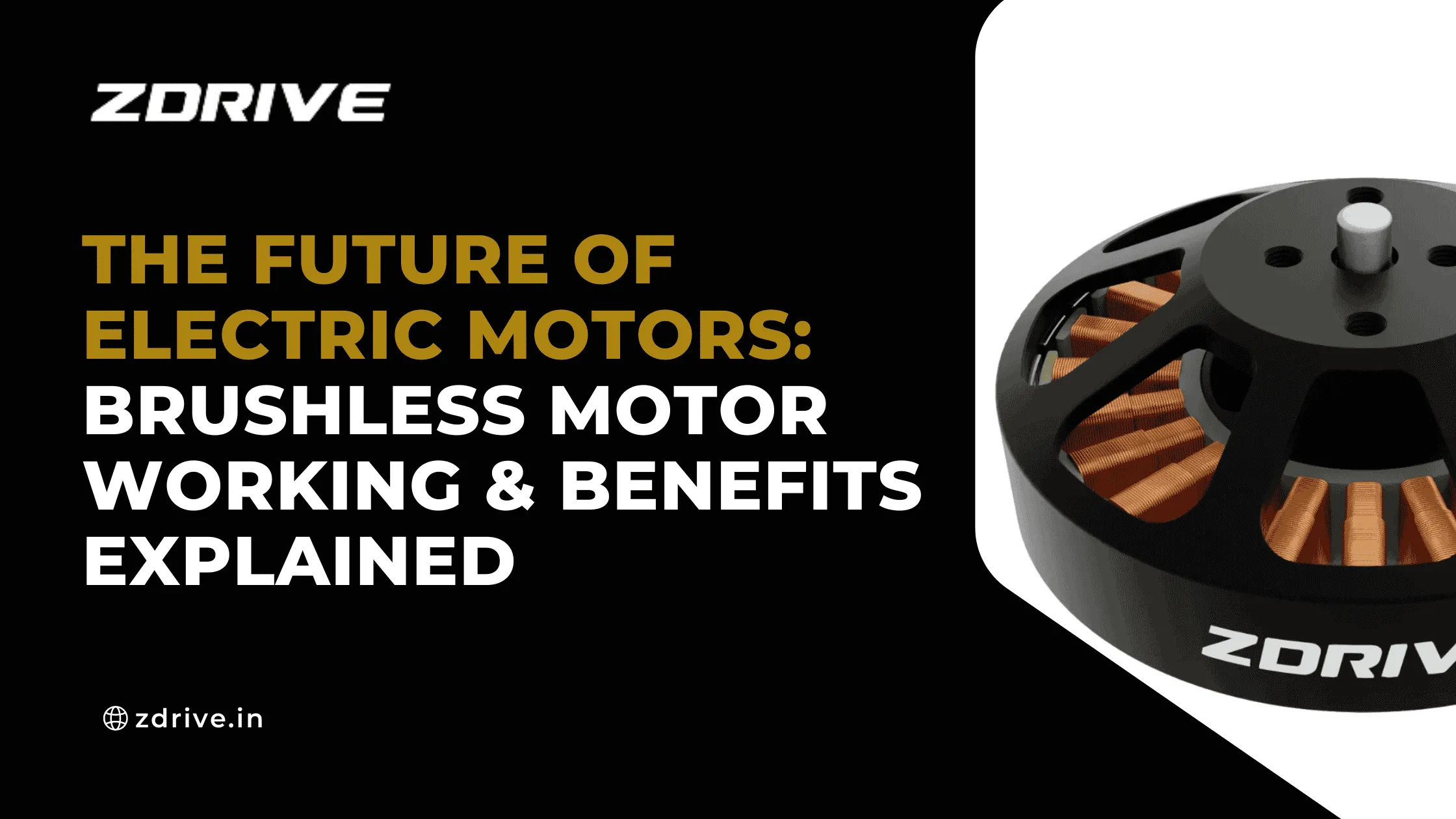
Basic Structure of a Brushless Motor
A BLDC motor consists of two main parts:
- Rotor (Permanent Magnets): The rotating part that creates a constant magnetic field.
- Stator (Electromagnetic Coils): The stationary part that generates a rotating magnetic field when current flows through it.
The controller acts as the brain of the system, intelligently managing the current flow in the stator coils to rotate the rotor continuously. This process enables precise torque control, faster response times, and better energy efficiency, making brushless motors ideal for drones, EVs, robotics, and high-performance industrial machinery.
As industries move toward automation, electrification, and sustainability, brushless motors are emerging as a key player in next-generation technology. They consume less power, generate less heat, and can be seamlessly integrated with AI-powered motor control systems, marking a major leap in smart engineering.
How Does a Brushless Motor Work?
To understand why brushless motors (BLDCs) are transforming modern machinery, it’s essential to examine how they operate. Unlike brushed motors that rely on mechanical friction to switch current, brushless motors use smart electronic control to deliver smoother, faster, and more efficient motion.
Step-by-Step Working Principle
- Electric Current Flows Through Stator Coils
When power is supplied, electric current passes through the stator’s copper windings. This creates a magnetic field inside the motor. - Magnetic Fields Interact with Rotor Magnets
The rotor, which contains permanent magnets, is attracted or repelled by the stator’s electromagnetic field. This interaction causes the rotor to rotate. - Electronic Controller Enables Continuous Rotation
The electronic controller (ESC) acts like the “brain” of the motor. It continuously switches the current between different stator coils, ensuring the rotor spins smoothly without requiring brushes or physical contact. - Real-Time Feedback for Speed & Torque Control
Modern BLDC systems utilize sensors or sensorless feedback to measure the rotor’s position and adjust the current flow in real-time. This provides highly accurate speed, torque, and directional control.
AI-Based Motor Control
AI-driven control systems now power the latest generation of brushless motors. These adaptive algorithms learn from performance data to:
- Optimize torque output based on load conditions
- Automatically reduce motor noise and vibration
- Extend lifespan by predicting wear patterns and adjusting power usage
- Improve energy efficiency for electric vehicles, drones, and robotics
In 2025, AI-based BLDC control has become a game-changer in industries demanding precision, such as aerospace, EV manufacturing, and autonomous robotics — where every watt of power and millisecond of control counts.
Brushless Motor Types and Configurations
Brushless DC motors (BLDCs) come in various designs and configurations, each optimized for specific performance requirements. Understanding these types helps engineers, drone makers, and EV designers select the right motor for efficiency, torque, and precision.
A. Based on Design: Inrunner vs Outrunner vs Disk Rotor
Inrunner Brushless Motors:
- The rotor spins inside the stator.
- Delivers high RPM (rotations per minute) and efficient heat dissipation.
- Common in RC cars, drones, and EV cooling systems.
Outrunner Brushless Motors:
- The rotor encases the stator, rotating outside it.
- Offers higher torque at lower speeds.
- Perfect for multirotor drones, e-bikes, and gimbals.
Disk Rotor Motors:
- Flat and compact with a disk-shaped rotor.
- Used where space-saving design is critical, such as in medical devices or robotics.
B. Based on Control: Sensored vs Sensorless Motors
Sensored Brushless Motors:
- Integrated sensors track rotor position for smooth startup and precise control.
- Ideal for industrial automation, robotics, and electric vehicles.
Sensorless Brushless Motors:
- No physical sensors; instead, they use back electromotive force (Back-EMF) detection for rotor positioning
- More cost-effective and suitable for high-speed drones or RC aircraft.
C. Based on Signal Type: Sinusoidal vs Trapezoidal Commutation
Sinusoidal BLDC Motors:
- Operate on a smooth, wave-like power signal.
- Provide quiet, vibration-free performance, ideal for medical and precision devices.
Trapezoidal BLDC Motors:
- Work with a block-shaped current waveform.
- Deliver more torque and higher efficiency at the cost of mild vibration.
- Preferred in industrial and high-speed drone applications.
D. Based on Pole Count: Single-Pole vs Multi-Pole Motors
Single-Pole BLDC Motors:
- Have one magnetic north and south pole pair.
- Support faster rotation speeds but lower torque output.
- Used in lightweight drones and fans.
Multi-Pole BLDC Motors:
- Contain multiple pole pairs for enhanced torque and smoother motion.
- Ideal for heavy-lift drones, EVs, and industrial robots.
Quick Comparison Table: Brushless Motor Configurations
| Category | Type | Key Strength | Best For |
| Design | Inrunner | High RPM, compact | RC cars, drones |
| Design | Outrunner | High torque, smooth | Multirotor drones, e-bikes |
| Design | Disk Rotor | Space-efficient | Robotics, medical devices |
| Control | Sensored | Precision at low speed | EVs, robotics |
| Control | Sensorless | Cost-effective, high-speed | Drones, FPV racing |
| Signal Type | Sinusoidal | Quiet, smooth motion | Medical, automation |
| Signal Type | Trapezoidal | High torque, efficiency | Industrial tools |
| Pole Count | Single-Pole | Faster rotation | Small drones, fans |
| Pole Count | Multi-Pole | High torque, stability | EVs, heavy drones |
Brushless vs Brushed Motors: Key Differences (Comparison Table)
When comparing brushless vs brushed DC motors, the gap in performance and efficiency has never been wider. While brushed motors once dominated the market due to their simplicity and low cost, brushless motors (BLDCs) now lead the way — powering everything from drones and e-bikes to electric vehicles (EVs) and industrial robots.
Core Difference Between Brushless and Brushed DC Motors
A brushed motor utilizes physical brushes and a commutator to transfer current to the rotor, resulting in friction, wear, and noise. A brushless motor, on the other hand, eliminates these parts — using an electronic controller to manage current flow and rotation digitally.
This simple shift in design creates major advantages in efficiency, reliability, and performance — especially critical in modern applications like drones, EVs, and automation.
Brushless vs Brushed DC Motor: 2025 Comparison Table
| Feature | Brushed DC Motor | Brushless DC Motor (BLDC) | 2025 Advantage |
| Efficiency | 70–80% (energy lost as heat and friction) | 85–95% (optimized power-to-performance ratio) | Brushless wins – higher power efficiency for EVs and drones |
| Speed & Control | Limited by mechanical friction | High-speed precision with electronic control | Brushless – smoother, faster response |
| Durability | Shorter lifespan (brush wear and tear) | Long-lasting (no brushes to replace) | Brushless – minimal maintenance |
| Maintenance | Frequent brush replacement and servicing | Low maintenance, only bearing checks | Brushless – cost-effective over time |
| Noise Level | Noisy due to brush contact | Quiet and vibration-free operation | Brushless – ideal for noise-sensitive applications |
| Cost | Lower upfront cost | Slightly higher initial investment | Brushless – better long-term ROI |
| Torque | Moderate and inconsistent | High torque with precise control | Brushless – stable torque across load range |
| Suitability for Drones/EVs | Not suitable for high efficiency or lightweight needs | Standard choice for modern drones and electric vehicles | Brushless – dominates the UAV and EV market |
| Lifespan | 1,000–3,000 hours (approx.) | 10,000+ hours with proper cooling | Brushless – 3–5x longer operational life |
Which Is Better for Drones or EVs?
Brushless motors for drones produce more stable thrust, less noise, and more overall efficiency; thus, they are extremely important for longer flight times and stable video recording. In the case of electric vehicles, BLDC motors consume less energy, require less cooling, and have a longer lifespan; thus, they provide a more environmentally friendly and powerful driving experience than their brushed counterparts.
Advantages of Brushless Motors
The global shift towards automation, electric mobility, and smart energy systems has led to brushless direct current (BLDC) motors becoming the leader that cannot be challenged in the motion technology sector. Their perfect blend of efficiency, reliability, and smart features makes them necessary across industries of the present and the future, from EVs and drones to robotics and precision healthcare equipment.
Here’s what makes BLDC motors the preferred choice in 2025:
1. Energy Efficiency: Power Without Waste
Modern brushless motors achieve efficiencies of up to 90–95%, thanks to electronic commutation that eliminates energy loss from friction and arcing.
- Reduced heat generation means less energy waste.
- Perfect for battery-powered devices, EVs, and long-endurance drones.
- Enhanced torque-to-weight ratio improves overall system performance.
2025 Insight: Next-gen BLDCs feature adaptive load balancing, allowing them to automatically adjust current flow and optimize energy use in real time — crucial for extending battery life in electric vehicles and UAVs.
2. Longevity & Low Maintenance: Built to Last
With no brushes or mechanical friction points, BLDC motors have a lifespan five times that of traditional brushed motors.
- No brush replacement means minimal downtime.
- Reduced internal wear ensures consistent performance over years of operation.
- Bearings are the only component that requires occasional servicing.
In 2025, maintenance-free operation will become a defining factor for industries adopting autonomous systems and continuous-run production lines.
3. High Precision & Control: Perfect for Automation and Drones
Brushless motors are engineered for micro-level precision. The use of electronic controllers and real-time sensors enables:
- Accurate speed, torque, and position control.
- Immediate response to variable loads.
- Flawless operation in robotics, 3D printing, CNC machines, and AI-driven drones.
Latest Trend: Integration with AI-powered motor controllers now allows predictive torque adjustments, ensuring smoother performance even in dynamic or unpredictable environments.
4. Noise-Free Operation: Quiet Power for Modern Spaces
Unlike brushed motors, BLDCs operate without electrical contact, resulting in nearly silent performance.
- Ideal for medical devices, office robotics, and home automation systems.
- No brush arcing means zero electrical noise, improving safety and reliability.
Example: In 2025, surgical robots and diagnostic devices utilize brushless motors for precise, whisper-quiet movement, a crucial feature in noise-sensitive applications.
5. Smart Integration: BLDCs Meet IoT and AI
The future of motion control lies in smart connectivity. Today’s BLDCs come equipped with:
- IoT sensors for remote monitoring and predictive diagnostics.
- AI algorithms that analyze performance data to reduce wear and optimize output.
- Cloud connectivity for real-time control in industrial networks.
This digital evolution transforms the BLDC motor from a mechanical component into an intelligent motion system capable of self-optimization and fault detection.
Brushless motors dominate the 2025 market because they deliver unmatched efficiency, durability, and intelligence, everything modern industries demand from motion systems. Whether it’s electric mobility, automation, or next-gen robotics, BLDC technology is the silent powerhouse behind innovation.
Common Challenges and Limitations
Brushless motors (BLDCs) are the preferred option in most cases of modern motion control. Nevertheless, they still have some problems. As factories are going to use them more in drones, EVs, and the systems of intelligent automation, only a few technical and economic restrictions are still there that limit the wide-scale usage, particularly in the quickly developing market of 2025.
1. Cost: High First Investment
Brushless motors are one of the primary areas where the higher upfront cost of the device becomes apparent when comparing the BLDC motor with a simple brushed one.
- The need for advanced electronic controllers (ESCs), the precision of components, as well as the requirement for high-performance magnets in the end product, all add to the price.
- Although the long-term benefits of less frequent maintenance are quite considerable, initial installation costs are still preventing some industries from taking this step.
2025 Insight: The electric and aviation industries are the main consumers of rare-earth materials and smart controllers; consequently, the prices of both have increased, thereby affecting the whole sector.
2. Complexity: Advanced Electronics Necessary and Must be Calibrated
A brushless DC motor requires an electronic commutation system. As a result, a dedicated ESC is required for operation.
- During the installation and setup process, it is necessary for the technician to possess the skills and knowledge required for sensor calibration, voltage, and torque limits.
- The system’s integration with IoT or AI-based technology leads to another level of complexity in terms of programming and synchronization.
Industries that lack trained technicians may find this complexity leading to a decrease in implementation and an increase in setup time.
3. Repair and Maintenance: Technical Expertise Required
Although BLDCs have few maintenance requirements, when situations arise that require repair, the problems are usually of the kind that necessitate complex electronic diagnostics rather than simple mechanical fixes.
- The causes of a malfunction in the controller or sensor may be that the person is unaware of the issue, which is why these faults are difficult to detect if the proper tools are not available.
- Replacing the damaged parts requires manufacturer-level assistance, which in turn leads to prolonged downtime and, consequently, an increased possibility of financial loss.
For instance, if the ESC is the component that fails in the targeted high-performance drones or robotics, then the whole system will be totally inoperative until after recalibration or replacement has been carried out.
4. Magnet Material Dependence: Rising Neodymium Costs
Brushless motors rely heavily on rare-earth magnets, such as neodymium and samarium-cobalt, for their high torque and compact size.
- In 2025, the cost of these materials has increased due to global supply chain pressures and EV demand.
- This dependence on limited resources raises concerns about manufacturing costs and sustainability.
Future Trend: One of the major goals for scientists is to find new ways to create alternative magnets for compositions, as well as to come up with magnet-free BLDCs that utilize advanced electromagnetic systems to lessen the need for rare materials.
Brushless motors remain the primary performers in terms of power and reliability; however, the issues of cost, complexity, and material sourcing will be the focus of their next stage of innovation. Furthermore, as time passes, the development of technology will enable the BLDC industry to be transformed by AI-controlled devices, eco-friendly materials, and repair systems that will become much simpler by 2030.
Applications of Brushless Motors
Brushless DC motors (BLDCs) have been the main power source of the radical change in the technology era; they are the engines of the future and the present, utilized in numerous fields such as drones without a pilot, electric vehicles, industrial robots, and intelligent consumer electronics products. Their unrivaled energy-saving, accuracy, and long-life qualities have made them indispensable in industries aiming for automation and environmental preservation.
Let’s explore where these motors are making the biggest impact:
Aerospace & Drones
In aerial systems, brushless motors deliver high torque-to-weight ratios, longer flight times, and whisper-quiet operation — critical for both commercial and defense UAVs.
- Enable stable flight control and real-time responsiveness in quadcopters and aerial mapping drones.
- Used in aerospace actuators, satellite systems, and autonomous air taxis for lightweight, reliable propulsion.
- Silent operation enhances performance in surveillance and wildlife monitoring applications.
2025 Trend: Integration of AI-driven motor controllers allows adaptive thrust management, optimizing battery use and flight stability in unpredictable weather conditions.
Automotive (EVs & Hybrids)
The precision of brushless motors fuels the electric vehicle revolution. Their high efficiency and regenerative braking capabilities redefine motion control in transportation.
- Deliver smooth acceleration, instant torque, and low energy loss.
- Support regenerative braking systems that recover energy during deceleration.
- Operate efficiently across a wide range of speeds — ideal for both EV drivetrains and hybrid powertrains.
Insight: By 2025, most new-generation EVs will utilize BLDC or PMSM (Permanent Magnet Synchronous Motors) for superior energy density and extended range performance.
Industrial Automation
From factory floors to AI-driven production lines, brushless motors have become the backbone of industrial efficiency.
- Power robotic arms, CNC machines, conveyor systems, and automated packaging units.
- Offer precise torque control essential for tasks requiring accuracy and repeatability.
- Reduced downtime due to low maintenance and longer operational life.
2025 Update: Smart factories now integrate IoT-enabled BLDCs, allowing predictive maintenance and real-time efficiency monitoring to prevent production halts.
Marine Systems
In marine environments, water-resistant BLDC propulsion systems are replacing traditional engines with quieter, cleaner, and more efficient alternatives.
- Power autonomous underwater vehicles (AUVs) and electric boats.
- Deliver high torque even at low speeds, ideal for maneuvering and exploration.
- Require minimal maintenance, ensuring reliability in harsh, saline conditions.
Emerging Trend: Hybrid BLDC propulsion, combined with solar or hydrogen-based systems, is driving the next generation of eco-friendly marine transportation.
Medical Equipment
Precision and silence make BLDC motors indispensable in the healthcare sector.
- Power surgical robots, ventilators, imaging devices, and lab automation systems.
- Offer smooth, vibration-free motion for enhanced accuracy and precision.
- Operate quietly to enhance the comfort of patients and healthcare staff.
Example: In 2025, most robotic-assisted surgical systems rely on miniature brushless motors for flawless motion during delicate procedures.
Consumer Electronics & Mobility Devices
From daily appliances to personal mobility, brushless motors power the convenience of modern living.
- Used in drones, e-bikes, vacuum cleaners, cooling fans, and wearable tech.
- Provide compact, efficient, and durable motion control with minimal noise.
- Extend battery life in portable devices through optimized energy management.
Insight: The rise of smart home automation and e-mobility has positioned BLDCs as a core component in over 60% of next-gen consumer devices.
The versatility of brushless motors continues to expand as industries embrace electrification, automation, and sustainability. Their efficiency, precision, and adaptability make them a cornerstone of modern engineering — from the skies to the seas, factories to homes.
Conclusion
Brushless motor (BLDC) technology has revolutionized the way we move, offering a more intelligent, environmentally friendly, and energy-efficient approach. This type of motor is the source of all the hype in the new tech world. Accordingly, the adoption of AI-based control systems and IoT connectivity continues to elevate motor intelligence to the next level, paving the way for a future characterized by precision and performance.
We manufacture high-quality BLDC motors and advanced drone components designed for long-lasting performance and reliability. Whether you’re building a next-generation drone, electric vehicle, or industrial solution, our products are built to deliver powerful and efficient motion control. Please explore our complete range of innovative products on Zdrive Technologies.
From smart drones to electric vehicles, the future of motion is silent, efficient, and brushless. Embrace the power of innovation and move forward with technology built for tomorrow.
FAQs
What is the lifespan of a brushless motor?
Brushless motors can last 10,000–20,000 hours or more, depending on usage and operating conditions. Since there are no brushes to wear out, they require minimal maintenance and deliver consistent performance over time.
Are brushless motors waterproof?
While most brushless motors are water-resistant, not all are fully waterproof. For outdoor or marine use, look for motors with IP65 or higher ratings to ensure protection against moisture and dust.
How do I choose the right ESC for my motor?
Match your ESC (Electronic Speed Controller) to the motor’s voltage and current ratings. Always select an ESC with an amp rating 10–20% higher than the motor’s maximum current draw for safe and efficient operation.
Can brushless motors be repaired or rewound?
Yes, brushless motors can often be repaired or rewound, but it requires expert knowledge and precision tools. For most users, replacement is more cost-effective than complex repairs, especially for compa